WORDS and IMAGES by ROSS COUPER PHOTOGRAPHY
Ross Couper is a prolific South African wildlife photographer who has won numerous awards and been published in several magazines. Growing up in Zimbabwe, Ross explored African wildlife forms through painting, drawing and sculpturing. Today he uses photography to encourage people to travel and explore the wildest parts of Africa.
Christie Fynn Morgan finds out what makes him tick.
CFM: Ross, what made you first pick up a camera?
RC: Photography happened because of a don’t-know-what-to-get-you-for-Christmas situation with my wife. As a result she purchased my first camera with the hope of topping my ‘Best Ever Christmas Gift’ list.
CFM: How much does your artistic ability influence your images?
RC: I am extremely lucky to have an extensive background in art and I am a bit of an intuitive photographer more than a practical photographer. This, with the combination of being a field guide and extensive knowledge of the subject matter, I do believe that I set out to do this unconsciously. I have the liberty of heading out into the bush to look for a specific shot and with this imagination, I have been able to use my artistic flare by capturing my subjects in unique poses at the best of times. Understanding your wildlife subjects’ behaviours and being able to manage your camera skills at the time required is vital for success.
CFM: Many of your iconic ‘Ross Couper’ images are photographs of monochrome leopards. Is this your favourite style and animal to photograph and why?
RC: My black and white work has really allowed me to highlight the wildlife subjects that I photograph. I spend countless hours with these wild animals and my black and white collection allows me to photograph them no matter what time of day it is or what the weather is doing. It is all about captured light in the right places that make them work well. As a self taught photographer, all the books I ever read about wildlife photography always spoke about the golden hour – and for years I kept chasing this theory thinking that if I was not able to photograph the animal at 60 minutes before dusk while the rays of the sun were pure golden with the exact light metering, then it was a wasted photo. My technical range limited my scope, so I spent countless hours reading more and getting to know my gear.
My days as a photographer were becoming limiting as any cloudy or rainy day squashed the notion of getting “the” picture. Only years later while capturing people in black and white did I start noticing the full impact a black and white picture could showcase. The black and white images could highlight the subject and with this monochrome effect, can lighten or darken the mood of the picture and often emit an emotion. Not long after did I put the old theory of the golden hour in my back pocket and started looking through my archives of photographs. As I started looking into the folder that was appropriately named the DUD file, I started noticing that the pictures I took – no matter if it was a rainy or cloudy day – had great potential once converted.
Leopards are my favourite animals to photograph! Tracking leopards can be one of the most rewarding tasks in the bush.
CFM: There are many young aspiring wildlife photographers out there who look up to you. Other than technical advice, what advice would you give them?
RC:
Destination.
Capturing that perfect moment would be based on areas that you have invested interest in. Wildlife throughout Africa consists of various species in a range of densities depending on the area. For instance, if you wanted to capture leopards in their natural habitat, the Sabi Sand Game Reserve in South Africa boasts one of the highest densities of leopard, along with many other species that could be viewed at very close range. It is often quite surprising to see just how habituated the wildlife is to the movement of the safari vehicles in that particular area. A destination can also dictate what equipment would be best used pertaining to that area and the species you are interested in capturing. In addition to the variety of abundant wildlife on the continent, landscape scenes are mesmerizing and can often become a great source of inspiration for wildlife photography.
Equipment.
- Know your gear. Get familiar with your equipment before your safari trip. I have seen many safari guests arrive with a brand new camera unfamiliar with its technical attributes and often opportunities are missed due to not being prepared or being familiar with their gear. This would be a very frustrating way to start your safari experience.
- Be prepared to shoot through many memory cards. Backing up your images on a laptop is a great idea, however having the cards available to switch out immediately is effective and in the event that a card does become corrupt for some reason you have plenty of backups.
- Spare batteries, I have learnt many a lesson arriving at a sighting and suddenly seeing my battery starting to flash. I often carry 2 spare batteries to avoid a few choice words being mumbled during a safari.
- With luggage restrictions on various airlines its recommended to source a photographic rental company within Africa that could be used, especially if you are wanting to use long fixed lenses like a 500mm or a 600mm f/4. Several private game reserves will often be able to view big game in close range and this can have one predetermine what lens would be required. In most cases a 70-200mm f/2.8 would be suitable. Needless to say that any longer lenses would be a bonus to use, particular for impact close up shots of wildlife. However, for action, the shorter zoom lens would be more suited. In most areas, wildlife is active in the low light conditions of the day. A low aperture lens can assist with the faster shutter speeds rendering a sharper image with high ISO capabilities, which most cameras have now.
Animal Behaviour.
It’s all about focusing on the eye… well as best you can. Wildlife is mostly active in the crepuscular hours (dawn and dusk) and on many occasions activity would be best captured during these golden hours. Utilizing low aperture lenses would be ideal in these low light conditions, the lower better. My ‘go to’ lens in most conditions is a 300mm f/2.8 or my 70-200mm f/2.8. They are lightweight, easy to carry and very rarely require support to capture a shot with a fast enough shutter to ensure that the image is sharp.
All wildlife species have varying behaviour which often allows one to predict an interaction or activity that may take place. It’s often recommended that if it’s your first time on safari it can be extremely useful to have a photographic guide escorting you during your stay at the various lodges. Most of the guides are often photographically minded as many of them have similar interests and they are familiar with the behaviour of the animals. This can often be useful when positioning the vehicle or understanding your interests in photography or the various species that you are specifically looking for during your stay.
Wildlife viewing is never guaranteed and on some occasions it can be frustrating, particularly as you are in vast areas where animals can roam freely, unbeknown to their presence in the environment. This is the rewarding factor when photographing a wild animal in its natural habitat. It creates a challenge to capture; there is no setup, no cue to the animal to pose and no place for someone without patience. Movement facing and space are all important to ensure you have composed correctly or that you have allowed enough space to crop the image as per your intention. The viewer would always be interested to see what the animal would be looking at.
Time.
This is one of the most important components to capturing an incredible image. Timing is everything; literally it’s everything when you have a great subject. It’s all about capturing the movement in perfect light and at the perfect time. Patience has been mentioned – it can be rewarding at times and sometimes it can be darn right frustrating to walk away with nothing. This is what drives your passion to be able to sacrifice time, waiting for that perfect moment.
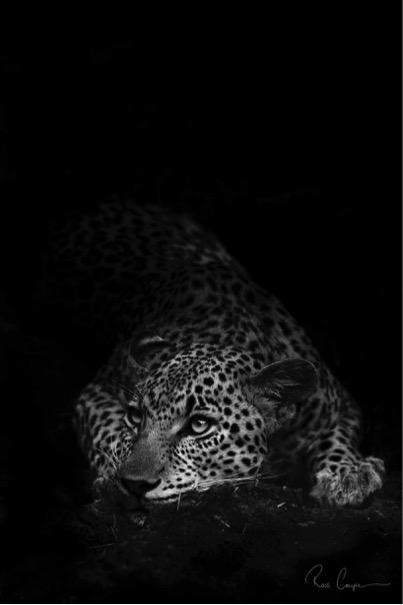 CFM: We know you’re a humble guy but if you could choose just one image that you feel is your ultimate photograph, which one would it be?
RC: Tough one – when trying to answer this question, I went through my photo folder and as I was doing it, I would choose one which I thought was my favourite and then look at the next picture and quickly move to that one as my new favourite – and I kept going! I read a saying once that “your best picture is the photograph that you capture tomorrow” – so I can never really choose my favourite picture. I do however have a picture that has inspired the start of my black and white collection and is sold as a limited edition. We were on a drive, passing a river bank, and often when looking for leopard you look in the forks of trees or under a bush, but this particular day I found the leopard on the banks of the river in a slipway that was used by crocodiles to bake in the sun or retreat to the water. The dark earth helped me highlight the leopard during the colour conversion and the result was amazing.
CFM: What message would you like your images to leave for future audiences?
RC: Print your favourite photos and display them. Experts are concerned about the storage of photographs. Computer hard drives have a lifespan of 10-20 years, CD’s and DVD’s around 10-25 years and USB flash drives perhaps 10,000+ read and write cycles. So it would be sad to know that the most photographed generation will have no pictures in 10 years unless the industry pushes more for cloud storing.
CFM: And lastly, they say that behind every great man, there’s a great woman. We know that your wife Lindsay is a huge inspiration and a core component behind Ross Couper Photography, a business you run together. As a couple, what is your favourite safari destination?
RC: We have recently been privileged to visit Singita Pamushana located in the Malilangwe Wildlife Reserve in Zimbabwe. They have incredible low-level hides that allow you to sit and watch the game come to drink. For a wildlife photographer – this has to be placed on their bucket list!
P.S. A little known fact is that Ross Couper is also an incredibly talented artist and not just brilliant wildlife photographer.
“It’s the serenity of Africa that makes it the most treasured piece on Earth, with wildlife and open spaces. Wild areas humble the spirit and inspire the soul – photographs embrace time.”
– Ross Couper
To view Ross Couper’s full collection, visit www.rosscouper.com.


